
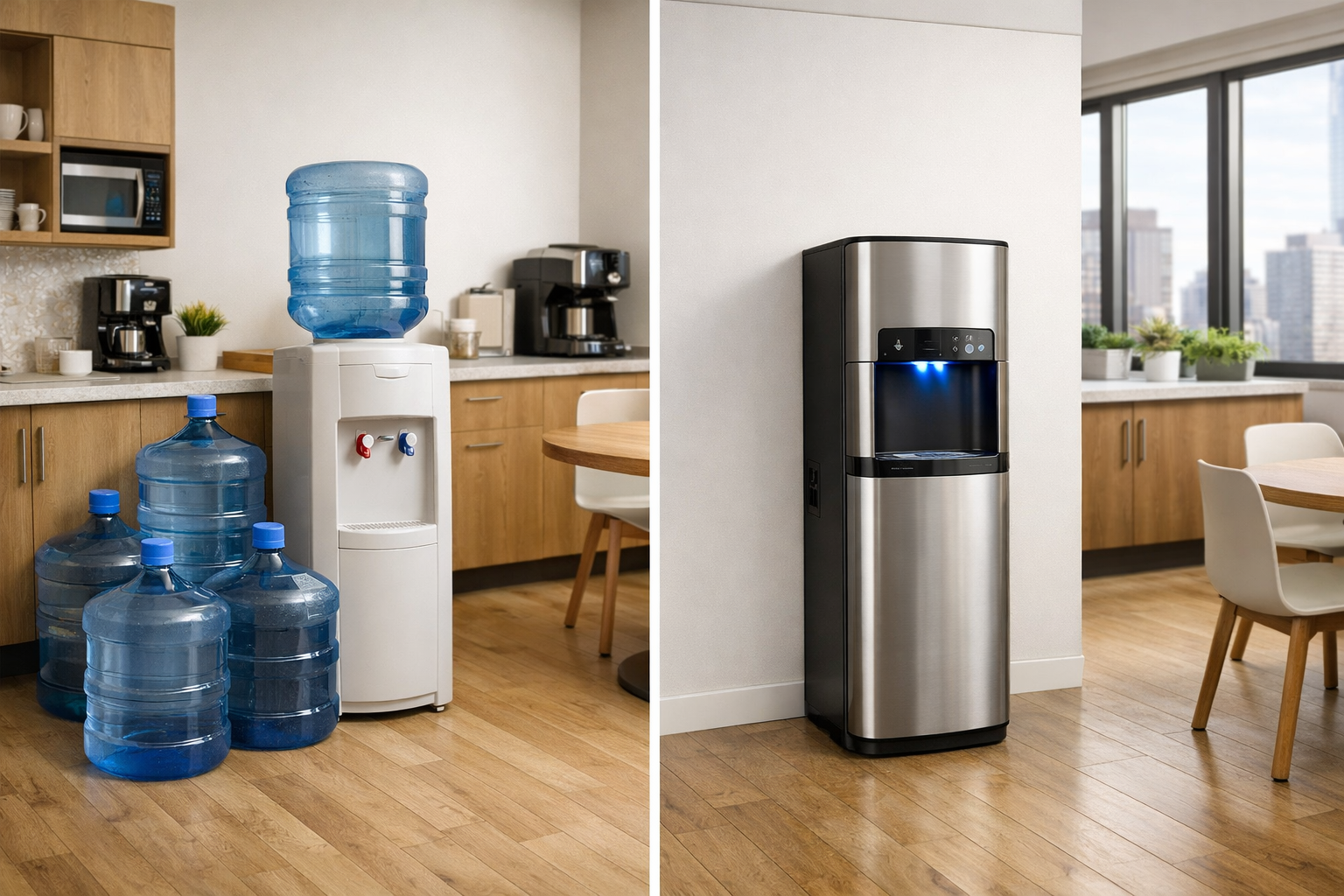
Bottleless vs. Bottled Water Cooler:
Which Is Better for Your Office?
For the vast majority of NYC offices, bottleless wins — on cost, hygiene, convenience, water quality, and environmental impact. Bottled water delivery made sense before direct-line filtration technology was widely available and affordable. It doesn't anymore. That said, there are specific scenarios where bottled still makes sense, and we cover those too.
- Bottleless water coolers connect directly to your water line and filter on demand — no deliveries, no jugs, no storage, no lifting.
- Bottled water delivery costs most offices $80–$200+ per month just in delivery fees — bottleless is a flat rental with zero per-gallon cost.
- Bottleless water is actively filtered and UV-protected 24/7 — bottled water sits in warm warehouse storage before delivery, where bacteria can grow.
- A typical 20-person NYC office generates hundreds of plastic jugs per year with bottled delivery — bottleless eliminates that waste entirely.
- Bottled has one legitimate advantage: independence from the building water supply — relevant for locations with unreliable supply or no water line access.
How Each System Actually Works
Bottleless Water Cooler
A bottleless cooler connects directly to your building's existing cold water supply line — typically the same line under a sink or near a water source. Water flows in continuously and passes through built-in filtration stages inside the machine: usually a sediment filter, carbon block filter, and GAC filter. Most units also include in-tank UV-C light for continuous bacterial protection. Filtered water is then chilled and/or heated and dispensed instantly on demand. There are no jugs, no deliveries, no storage, and no scheduled swaps. The machine runs on your building's supply indefinitely.
Bottled Water Cooler (5-Gallon)
A bottled cooler uses pre-filled plastic jugs — typically 5 gallons, weighing about 42 lbs when full — that are inverted onto the top of the machine or loaded into a bottom-load compartment. When the jug empties, someone swaps it manually. A delivery service brings new jugs on a schedule (usually weekly or biweekly) and collects the empties. Between deliveries, your office must store spare jugs somewhere — typically in a closet or storage room. When you run out, you're out until the next delivery.
- ✕Water sits in jugs stored in warm warehouses before delivery
- ✕42 lb jugs require manual lifting — common workplace injury source
- ✕Requires storage space for spare jugs
- ✕Runs out between deliveries if usage is higher than expected
- ✕Delivery schedules can be disrupted by weather, strikes, or supplier issues
- ✕No active filtration inside the machine once jug is loaded
- ✕Typically only hot + cold — no ice or sparkling option
- ✓Filtered on demand, directly from your water line — always fresh
- ✓No lifting — zero physical handling of water
- ✓No storage needed — machine connects to your existing supply
- ✓Unlimited supply — never runs out as long as building water flows
- ✓No delivery dependency — fully autonomous once installed
- ✓UV-C light neutralizes bacteria in tank 24/7
- ✓Hot + cold, or Water + Ice, or Water + Sparkling options available
Complete Head-to-Head Comparison
Every factor that matters for an NYC, NJ, or Upstate NY office — side by side.
| Category | 🔵 Bottleless | 🫙 Bottled (5-Gallon) |
|---|---|---|
| Monthly Cost | Flat rental — no per-gallon cost | $80–$200+ in delivery fees alone |
| Installation | Free professional install — under 1 hour | Drop-off delivery — no install needed |
| Water Supply | Unlimited — direct line connection | Limited to jugs on hand — can run out |
| Filtration | 3-stage active filtration at point of use | Pre-filtered at plant — no filtration in-machine |
| Bacteria Protection | UV-C light active 24/7 in tank | No active protection — warm storage risk |
| Physical Effort | Zero — no lifting, swapping, or handling | 42 lb jugs — manual swap every few days |
| Storage Required | None | Spare jugs need closet/storage space |
| Plastic Waste | Zero plastic bottles | Hundreds of large jugs annually |
| Carbon Footprint | No delivery trucks — dramatically lower | Weekly truck deliveries add up |
| Maintenance | Fully handled — filter changes included | Order jugs, manage delivery schedule |
| Water Options | Hot, cold — or add Ice or Sparkling | Hot + cold only from the jug |
| Supply Independence | Requires building water supply | Works without building water connection |
| Ideal For | Offices, gyms, warehouses, schools, healthcare | Temporary sites, areas without water lines |
The Real Cost Breakdown
Bottled water delivery costs are consistently underestimated by offices that have been on it for a while — the fees normalize and no one questions them. Here's what the actual numbers look like for a typical NYC office of 20–30 people.
Bottled delivery costs scale linearly with usage — more people means more jugs means more fees. Bottleless cost stays flat regardless of how much water your team drinks. A 50-person office paying $300+/month in delivery fees switches to bottleless and pays a fixed rental — the savings compound every month.
Water Quality & Hygiene: The Case Against Bottled
This is where bottled water has a serious disadvantage that most people don't think about. The assumption is that water that arrives in a sealed jug is inherently clean and safe. The reality is more complicated.
The Warm Storage Problem
5-gallon water jugs are filled at a plant, sealed, and then stored — often in a warehouse for days or weeks before delivery. Warehouses are not climate-controlled at refrigeration temperatures. Warm + stagnant water is an ideal environment for bacterial growth. Common organisms including coliform bacteria, Pseudomonas, and in worst cases Legionella can multiply in improperly stored bottled water. Once the jug is loaded onto your cooler, the exposed neck of the dispenser is open to ambient air and whatever is in your break room.
Bottleless coolers filter water on demand from a sealed system connected to your water line. UV-C light runs continuously inside the tank — neutralizing bacteria 24/7 even when no one is dispensing. There's no warm storage window, no manual handling of the water source, and no exposed dispenser neck.
3-stage filtration handles the real contaminants in NYC's municipal supply: chloramine taste and odor, sediment, lead from older building pipes, VOCs, pesticides, and disinfection byproducts. The result is cleaner, better-tasting water than what comes from the tap — and cleaner than water that spent two weeks in a warehouse.
What About Reverse Osmosis?
For offices in parts of Upstate New York or New Jersey where source water has elevated dissolved solids, arsenic, nitrates, or PFAS, Cold Office Water also offers RO bottleless coolers — 4-stage and 5-stage with mineralization. The comparison with bottled water stays the same: bottleless wins on hygiene, cost, and convenience, with the additional benefit of deeper purification for locations that need it.
Environmental Impact: It's Not Even Close
If your office cares about its environmental footprint — and increasing numbers of NYC businesses do, for both ethical and regulatory reasons — bottled water delivery is hard to justify at scale.
Plastic Waste
A 20-person office consuming water at a normal rate goes through roughly 4–6 five-gallon jugs per week. That's 200–300+ jugs per year from a single office. While 5-gallon jugs are designed to be returned and refilled (not single-use), the system has losses — damaged jugs, jugs that get missed on pickup, jugs that eventually crack and are discarded. Over a 2-year period, a typical NYC office generates significant plastic waste from its water system alone. Bottleless: zero.
Delivery Emissions
Every delivery truck that comes to your office burns fuel. For a weekly delivery, that's 52 truck trips per year for your office's water alone — and delivery routes serve multiple stops, but the emissions from the water delivery portion of that truck's operations are real and measurable. Bottleless coolers require no recurring deliveries once installed. The ongoing carbon footprint is essentially zero beyond the electricity the machine uses.
Cold Office Water has a carbon savings calculator that shows exactly how much CO₂ and plastic waste your office eliminates by switching to bottleless. Try the calculator →
When Bottled Still Makes Sense
We sell bottleless coolers — so take this section as a genuine attempt to be fair. There are real situations where a bottled cooler is the better practical choice.
✅ Bottleless is the better choice when:
- 🔵You have a permanent office with a water supply line accessible near where the cooler will sit
- 🔵Your team drinks enough water to make delivery costs significant
- 🔵You want filtered, UV-protected water with zero ongoing management
- 🔵You care about reducing plastic waste and delivery emissions
- 🔵You want hot + cold, or need ice or sparkling water options
- 🔵You're in NYC, NJ, or Upstate NY — all served by Cold Office Water
🫙 Bottled may make more sense when:
- ⚪Your space has no accessible water supply line and running one isn't feasible
- ⚪You're in a temporary location — a pop-up, a short-term lease, or a construction trailer
- ⚪Your building's water supply is genuinely unreliable or frequently shut off for extended maintenance
- ⚪You have a very small team (1–3 people) where delivery costs are minimal
Our Honest Verdict
For any established NYC office, gym, warehouse, school, or healthcare facility with a normal water supply connection, bottleless is the clear choice. The only scenarios where bottled makes genuine sense are temporary setups or locations with no water line access. If you're not sure whether your space can accommodate a bottleless cooler, reach out — we'll assess your location before any commitment is made.
Ready to Switch? Start with 7 Days Free
We install it, you test it. Free professional installation included. Serving NYC, NJ & Upstate NY offices, gyms, warehouses, and more.
7-Day Trial · 24-Month Minimum Rental Term · Free Installation